Mesh Processing Non-Meshes via Neural Displacement Fields Eurographics 2026
Yuta Noma¹, Zhecheng Wang¹, Chenxi Liu¹, Karan Singh¹, Alec Jacobson¹²
¹University of Toronto, ²Adobe Research
Abstract
Mesh processing pipelines are mature, but adapting them to newer non-mesh surface representations—which enable fast rendering with compact file size—requires costly meshing or transmitting bulky meshes, negating their core benefits for streaming applications.
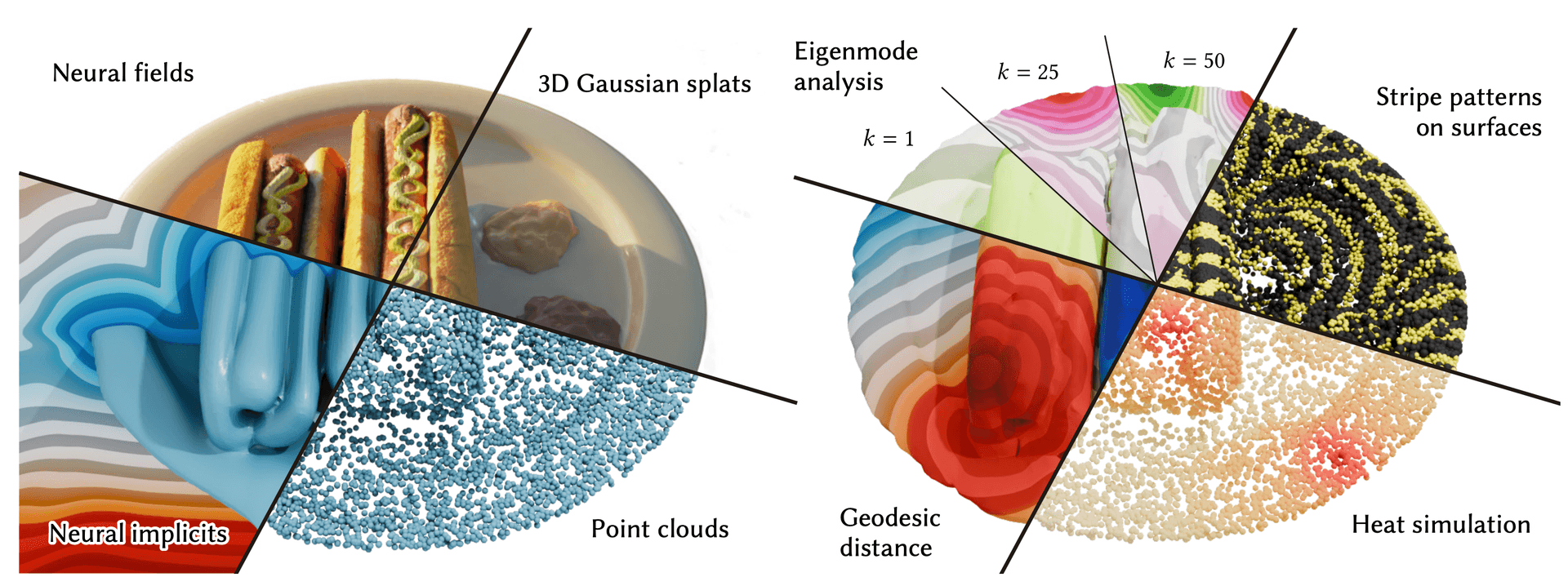
We present a compact neural field that enables common geometry processing tasks across diverse surface representations. Given an input surface, our method learns a neural map from its coarse mesh approximation to the surface. The full representation totals only a few hundred kilobytes, making it ideal for lightweight transmission. Our method enables fast extraction of manifold and Delaunay meshes for intrinsic shape analysis, and compresses scalar fields for efficient delivery of costly precomputed results. Experiments and applications show that our fast, compact, and accurate approach opens up new possibilities for interactive geometry processing.
Downloads
3D Plot
Our method aims to extend the Pareto frontier of three properties: error in computation tasks, runtime of mesh extraction + solve, and file size. Here, we show that the data points of our method (orange) form a new Pareto frontier that is impossible to achieve with existing methods. The 3D plots below are interactive — drag to rotate, scroll to zoom, and shift-drag to pan.
BibTeX
@article{noma2026neuraldisplacement,
  title = {Mesh Processing Non-Meshes via Neural Displacement Fields},
  author = {Yuta Noma and Zhecheng Wang and Chenxi Liu and Karan Singh and Alec Jacobson},
  year = {2026},
  journal = {Computer Graphics Forum (Eurographics)},
}
Acknowledgements
We thank Jonathan Panuelos and Abhishek Madan for insightful discussions, and Thor Vestergaard Christiansen, Joonho Kim, and Victor Rong for proofreading. Our research is funded in part by NSERC Discovery (RGPIN-2022-04680), the Ontario Early Research Award program, the Canada Research Chairs Program, a Sloan Research Fellowship, the DSI Catalyst Grant program and gifts by Adobe Inc.